11th Aug 2025: BBC Interview with PCyC
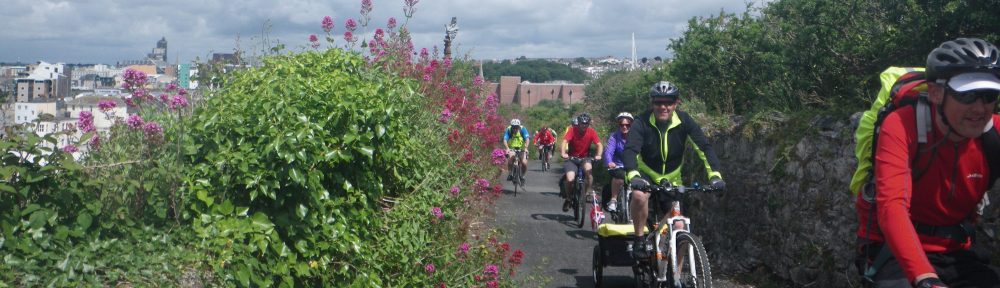
“Council lacks will to encourage active travel ” The BBC met with representative of PCyC “Hazardous” – that is how Mark Swarbrick from the Plymouth Cycling Campaign has described getting around the city by bike”
To see the article click here
15th July George Park & Ride. Application for a Lawful Development Certificate Update
Other than an auto-reply we do not seem to have had a reply from PCC. We have sent another email and also it has been brought to our attention that it seems in the original announcement back in 2021 that a second level was going to be added to provide for 350-500 cars including 100 EV Charging bays. We have included this in our latest email to PCC.
July 7th 2025: George Park & Ride. Application for a Lawful Development Certificate
PCC (Plymouth City Council) have applied to Change the existing segregated footway/cycleway along Plymbridge Road to a 3.5m shared use path to facilitate building 83 more car parking spaces in the George Park and Ride. To see our response click here This has been sent to PCC and we will update if we hear any further information.
January 29th 2025: Integrated National Transport Strategy: a call for ideas
According to their website “The Department for Transport, want to hear from:people who use any form of transport, including cars, vans, motorbikes, mopeds, trains, underground, metro, trams, buses, minibuses, coaches, bikes, e-bikes, walking or wheeling”
Please make the voices of people who walk, wheel and cycle heard click here to access the DofT page and online questionnaire
Vegetation Meeting between PCyC and PCC Jan 2025
PCyC Members met with PCC Staff including the ‘Street Services Team Leader’ to discuss the management of overgrowth of vegetation principally due to the recent problems at Forder Valley and The Embankment. Click Here for a Summary of that meeting
SEPT 11th 2024
In July PCyC contacted new and re-elected MPs in our locale to engage them regarding cycling and wheeling. We want to follow this up with specific questions with a view to meeting them to discuss. We have drawn up a list of potential topics (below) and would like your input on the current list and suggestions for other items.
New large-scale projects will struggle for funding, but it is nevertheless important to make local decision makers aware of our priorities. The Transport Minister has said “The Labour government will invest unprecedented levels of funding in cycling and walking as a critical part of plans to improve health and inequality” so we are hopeful there will be some cash forthcoming!
So please let us know what item(s) on the list you consider a priority or add your suggestions to the list, so we can represent your views to the people who matter.
Luke Pollard: Plymouth Sutton & Devonport
- City Centre Cycling
- St Budeaux to Dockyard / Dockyard to City Centre route
- Eldad Hill Crossing
- Embankment. (NCN2 As a whole) Short term to re-surface the Embankment. Longer term improvements along the whole of the NCN2.
- Efford Pathway improvements: section between Military Rd to Willow Close
Fred Thomas: Moorview
- Forder Valley. Improve narrow shared route, maintenance and filling station issues.
- A decent, safe North – South route along Tavistock Road between Crownhill and Manadon
Rebecca Smith: South West Devon
- Under Colesdown Hill route update
- Continuation of traffic-free route to Sherford from Deep Lane
- Dawes Lane alternative – land negotiations
- Re-instating the bridge across the entrance channel to Hooe Lake to link Oreston and Turnchapel
- Deep Lane Overbridge re-submission by DCC.
- improvements to NCN2 (Plympton)
- Improvements to NCN 28 (Brixton – Elburton)
- Market Road to Station Road in Plympton – an alternative traffic free route needed. (See above NCN 2 Plympton from GW)
Anna Gelerd: SE Cornwall
- Carrying e-bikes on Cremyll Ferry
- Saltash and beyond cycle routes
- Plans to improve links around Rame https://letstalk.cornwall.gov.uk/looe-valley-trails
Sir Geoffery Cox: Tavistock and Torridge
- Yelverton to Roborough path (n.b. Since boundary change this route falls within both Torridge and Tavistock and SW Devon)
General (Cross Constituency)
- Cycle lane & shared path parking enforcement
- Maintenance of Current Cycle Infrastructure
- Future engagement, how best to continue a dialogue over the course of this Parliament. As Government plans emerge post spending review
- Illegal e-bike issues and general e-bike legislation
JULY 3rd 2024
Issues with Overgrown Vegetation on Cycle Routes
PCyC and others are urging Plymouth City Council (PCC) to cutback overgrown vegetation presenting a hazard to people on bikes and other wheelers along Forder Valley and the Embankment. These already poor routes are severely affected by trees and shrubs further narrowing already narrow paths, forcing cyclists out near the kerb and closer to the heavy fast moving traffic, whilst vegetation overhead catches helmets and clothing.
PCyC have emailed PCC with our concerns and have sent them a video which highlights the issue, they have replied that email and the video have been sent to the Highways department.
We urge you to keep pressuring PCC to sort this is issue out by reporting it using the Online Reporting, click here also please contact your local councillor.
Cllr John Stephens The PCC Cycling Campaign has raised the issue with PCC Highways for immediate attention and with a view to establishing year round maintenance of these routes.
To keep up to date on this and see the videos of the issues we have made, please follow this on our Facebook Forum
MARCH 29th 2023
PCyC action on cuts to Active Travel Fund announced 9th March 2023.
The Transport Secretary announced on 9 March, that dedicated active travel funding for the next two years is being reduced from £308 million to only £100 million.
This represents a two-thirds cut to promised capital investment in infrastructure for walking, wheeling and cycling.
Defunding active travel is a backward move for the economy, the climate and health, and the effect will be catastrophic for cycling in England. It effectively puts the Government’s Gear Change strategy to increase levels of walking and cycling in reverse
PCyC Has written to all three local Plymouth MPs, Gary Streeter, Luke Pollard and Johnny Mercer on this issue. The questions posed are below followed by the responses.
Email to all MPs from PCyC
“You are no doubt aware that on March 9th the Transport Secretary announced a cut in the budget for active travel schemes in England. This includes a two thirds cut to promised capital investment in infrastructure for walking, wheeling and cycling, from £308 million to only £100 million for the next two years. The Walking and Cycling Alliance WACA, which includes all the major walking and cycling organisations has sent an open letter to Rishi Sunak urging the prime minister to reverse the decision to slash the budget for active travel schemes in England. This letter was published in the Times.
As someone who strongly supports active travel, PCyC would be interested in your views on these cuts and whether this indicates a departure in government policy of prioritising walking and cycling.”
The email to Luke Pollard also included:
‘Should Labour win the next general election, how firmly committed is it nationally to properly funding walking and cycling?’
Response from Sir Gary Streeter
“Thank you for your email and I share your disappointment although I recognise the challenge of balancing so many competing demands including Defence and the NHS.
In the midst of the pandemic, we saw quieter roads, buses and trains. This was largely to be expected given the necessary public health restrictions in place. However, during this time of disruption for much of the transport network, previously unsung forms of travel thrived. Cycling rates increased by 46% and a million more people started walking for leisure. Quieter roads and less congestion gave many new cyclists the space, confidence and opportunity to get behind their handlebars.
Despite the reduced expenditure to the national active travel funding, the Government remains committed to the goal that 50% of all journeys in towns and cities should be walked or cycled by 2030. Active Travel England have been tasked with meeting this target and they will work alongside local authorities to ensure people have the high-quality infrastructure needed to make active travel part of their everyday lives.
I will make representations although I fear the die may already be cast.
Best wishes, Gary”
Response from Luke Pollard
“Thanks for this. I want to see more, not less, investment in walking and cycling. I hadn’t heard the phrase, walking, wheeling and cycling before but I like it!
Labour will be setting out more on our spending commitments closer to the election but we are very much in favour of encouraging more modal shift out of cars and walking and cycling infrastructure is key to this happening.
I have asked a Parliamentary Question about what the cuts are to the south west from the overall cut in budgets and will ask that this is sent to you when I receive it.
Keep campaigning!
Best wishes,
Luke
Luke Pollard MP
Labour and Co-operative Member of Parliament for Plymouth Sutton and Devonport”
Response from Johnny Mercer
Thank you for contacting me to raise your concerns about the cuts to the active travel scheme. As well as being greener, active travel helps to reduce pressure on public transport and the road network.
The Government invested over £850 million in active travel between 2020/21 and 2022/23. It
has also committed to spending at least a further £100 million capital into active travel over the remainder of the spending period, as part of a £3 billion investment in active travel over the course of this Parliament. Further, the newest version of the Highway Code introduces a ‘hierarchy of road users’, a concept whereby the road users able to do the greatest harm are bestowed the greatest responsibility to reduce the danger or threat they may pose to other road users. The hierarchy is designed to bring about a more mutually respectful and considerate culture of safe and effective road use that benefits all users. At the top of the hierarchy is pedestrians (in particular children) older adults and disabled people, cyclists, horse riders and motorcyclists.
I intend to raise the importance of active travel, and continue engaging with ministerial
colleagues who I know share your desire to see continued investment in cycling and walking.
I do hope this information is helpful to you. Should you wish to discuss this matter further,
please do not hesitate to contact me again.
Join Us!
We have asked our subscribers and Facebook followers to email their MP on this issue. If you would like to join the Plymouth Cycling Campaign to help further the cause of Cycling in the Plymouth area please head to our Membership page.
OCTOBER 6th 2022
Who are ‘cyclists’? Re-thinking the terminology we use to discuss cycling.
As you may have seen, Helen Pidd recently wrote a piece in The Guardian discussing a rise in anti-cyclist sentiment in the UK. We spent some time in a recent PCyC committee meeting discussing these worrying behaviours – many of us whom have experienced similar instances when on our bikes in recent times. We agree that these long-running issues require urgent addressing by local authorities and the national government, and we continue to push for these here at PCyC.
In particular, we would like to pick up on one point made within the piece about the terminology we use to describe people who cycle. Chris Boardman decided to stop using the word cyclist, preferring “person on a bike” because it is a reminder there is a human in the saddle. ‘Cycling is just lazy walking,’ says Boardman. ‘That’s how we need to see it. That’s what it is in the Netherlands, where 60% of kids ride to school every day. They don’t do it because they’re cyclists. They don’t think of themselves as disciples. They just go to school and cycling is the easiest way to do it.
Importantly, Boardman’s comments about the power of language are reflected in numerous scientific studies on cycling promotion and uptake. There is strong evidence that the term ‘cyclist’ – thanks largely to framing in the media – evokes negative imagery of the behaviour and people who cycle. For example, a study in Australia identified that the term ‘cyclist’ conjured images amongst participants of ‘risk takers’, ‘law breakers’, and whose riders were ‘serious and sporty’. In another UK-based study, participants were asked to describe their understandings of who ‘cyclists’ were – with the most common responses relating to low-income communities (i.e. people who couldn’t afford to drive) or high-income groups (i.e. generally middle-aged men who took cycling seriously). The conclusions of these studies – and many others (some of which we have linked below) – is that the term ‘cyclist’ carries connotations that sees those riding bikes as othered (i.e. different from drivers in a negative way). It is evidenced that such connotations also stop people taking up cycling in the first place.
In response, at Plymouth Cycling Campaign, we have decided to replace the word ‘cyclist’ with ‘adults and children who cycle’ in our conversations and communications. The move follows studies that suggest we need to think of new ways of framing cycling in order to encourage participation – particularly in young families. We believe that the phrase reflects a more holistic and inclusive understanding of cycling behaviour that breaks away from some of the above connotations. It infers that those on a bike aren’t cyclists, but are rather people choosing to travel in a particular way. The phrase emphasises that different kinds of people cycle (adults and children) and highlights that these also include vulnerable groups. We hope that the phrase works to shift public perceptions of who is on a bike (and, thus, how they should be treated).
It is important to state that we are not arguing that this is the solution to all of the issues highlighted in Pidd’s Guardian piece. There is significant work, investment, and attitude/behaviour change that needs to take place across all sectors of society to ensure that we create sustainable, safe, and inclusive futures. However, this is a small step that we can take in our everyday conversations that can begin to make a difference.
Scientific studies on the effects of ‘cyclist’ terminology:
BONHAM, J., JOHNSON, M., & HAWORTH, H. (2018). Cycling related content in the driver licensing process. Transportation Research Part A: Policy and Practice, 117, 117-126
DALEY, M., & RISSEL, C. (2011). Perspectives and images of cycling as a barrier or facilitator of cycling. Transport Policy, 18[1], 211-216
DICKINSON, J., & ROBBINS, D. (2009). “Other People, Other Times and Special Places”: A Social Representations Perspective of Cycling in a Tourism Destination. Tourism and Hospitality Planning & Development, 6[1], 69-85
ENGLISH, P., & SALMON, P. (2016). New laws, road wars, courtesy and animosity: Cycling safety in Queensland newspapers. Safety Science, 89, 256-262
HORTON, D. 2007. “Fear of cycling”. In Cycling and Society, Edited by: Horton, D., Rosen, P. and Cox, P. 133–152. Aldershot: Ashgate. NIELSON, R., & BONHAM, J. (2015). More than a message:
OCTOBER 7TH 2021
Plymouth Cycling Campaign (PCyC) Response to Plymouth City Council’s Consutation re LCWIP (Local Cycling and Walking Infrastructure Plan)
Plymouth Cycling Campaign is a non-statutory consultee recognised by Plymouth City Council
Foreword
As a cycling campaign, we are committed to make it easier for people to cycle throughout the city and into the neighbouring areas outside the city boundaries. We recognise that cycling is one part of the active travel agenda and the LCWIP but have limited our comments to cycling aspects only.
Cycling is increasingly popular locally as a leisure activity and more people are using bikes to cycle to work, school or for utility journeys but the numbers remain low. We have noticed increased use of electric bikes, especially among the older age group such as recently when a gentleman age 92 was accompanied by one of our committee on a hilly cycle ride of 22 miles in South Hams. Equally young children and families have joined rides with us and will cycle when they feel safe.
Our cycling design criteria are reproduced from Table E/1.1.1 of CD195 as follows:
- Coherence: Cycle networks link trip origins and destinations, including public transport access points and are continuous and easy to navigate.
- Directness: Cycle networks serve all the main destinations and seek to offer an advantage in terms of distance and journey time.
- Comfort: Infrastructure meets design standards for alignment and surface quality, and caters for all types of user, including children and disabled people.
- Attractiveness: Aesthetics, noise reduction and integration with surrounding areas are important.
- Safety: Cycle networks not only improve cyclists’ and other road users’ safety, but also their feeling of how safe the environment is (their personal security).
Our policy mirrors DfT Cycle Infrastructure Design LTN1/20, Highways England CD195 and UK Government Climate Emergency which calls for 50% of all journeys in urban areas to be walking or cycling by 2030.
Barriers against Cycling
Local people consider Plymouth to be hazardous for cycling. There are limited through routes connecting urban areas and what infrastructure has been provided is often piecemeal and fragmented. On road cycle lanes that currently exist are not acceptable to the public. The Government’s accepted view is that reasonably healthy people can cycle up to 5 miles for travel to work or school. In our opinion, this can be increased to 10 miles with an electric bike. People will not cycle unless the 5 design criteria described above have been met and this does not exist in Plymouth.
The city has shown that it knows what to do but has not delivered it. Examples of good practice may be seen alongside the A379 but the problem is that nothing is complete. These good examples include taking out unnecessary traffic lanes, provision of wide traffic free paths and provision of a parallel crossing. More good practice can be seen in the SCN published in 2017 which we supported at the time.
Developing an LCWIP for Cycling.
We support the principle using the six generators as the Consultation sets out and welcome the principle of having route plans that have had some detailed work done on them already for when funding becomes available. However, we also note that Route 1 and 2 in the audited cycle routes are graded as ‘low’ cost schemes. We would urge PCC to allocate some of their own highways budget to funding these schemes so that the LCWIP makes a difference on the ground and gains momentum.
The draft LCWIP recognises that some of the routes pose real challenges, and we acknowledge and welcome that positive proposals have been put forward rather than just putting those routes in the ‘too difficult’ pile and looking for something easier.
It is also encouraging to see that data about real journeys people are already making by non-cycle modes of transport is being used from the Propensity to Cycle Tool, albeit based the 2011 census. However, there is a lack of data about actual cycle journeys made in Plymouth and more needs to be done to establish an accurate picture of which routes are most popular and/or which routes most people would choose to use if they were better. Other sources of data are also available about existing and potential cycle journeys and new methods of collecting real time data are available (for example from https://seesense.cc/pages/planners) and we would like to see greater use of these sources to prioritise investment in the cycling network.
We also welcome the inclusion of references to consideration of 20 mph zones even on non-residential roads and re-allocation of road space in some of the cycle route proposals but urge greater use of these interventions to maximise the potential for more journeys by bike in Plymouth.
We also have the following comments:
- We have noted the audited proposals for cycle routes and consider that they are fairly minimal (just 4 routes). The city must be more ambitious to meet the Government’s target of 50% of journeys within the city to be walking or cycling by 2030. In order to achieve this goal, the aspirations and delivery need to be more ambitious so that active travel becomes the natural first choice for journeys within Plymouth.
- No account is taken for travelling into Plymouth from surrounding areas such as Yelverton, Ivybridge, Yealmpton and the proposed Freeport.
- Existing routes are not referenced in the document even though there is considerable potential for new cycling and walking journeys if those routes were upgraded.
We consider therefore that the first issue LCWIP for cycling should comprise the following as a minimum in addition to those already identified:
- Upgrade the Embankment due to its strategic location, including links to the city and train station
- Roborough – City
- Langage – Sherford – Elburton
- Saltash – City
- Saltash – Derriford – Woolwell
- Ivybridge – Marsh Mills – City
- Ivybridge – Derriford –Woolwell
- Yealmpton – Elburton – City
In addition, we would like to see more emphasis on developing further low traffic neighbourhoods and the introduction of 20mph speed limits in residential areas as standard. Subsequent LCWIP routes could then be developed to act as arteries linking these safer, lower traffic / lower speed neighbourhoods which would have a significant impact on making people feel safer on two wheels.
If the intention is to update and review the LCWIP annually, we would welcome this. This first stage document is extremely important and we believe that our proposals above should be incorporated within the document to reflect the needs of cyclists as we understand it.
Submitted to Plymouth City Council October 3rd 2021 by Plymouth Cycling Campaign (a recognised non-statutory consultee)
______________________________________________________________
21st May 2021
MP LENDS SUPPORT TO ACTIVE TRAVEL
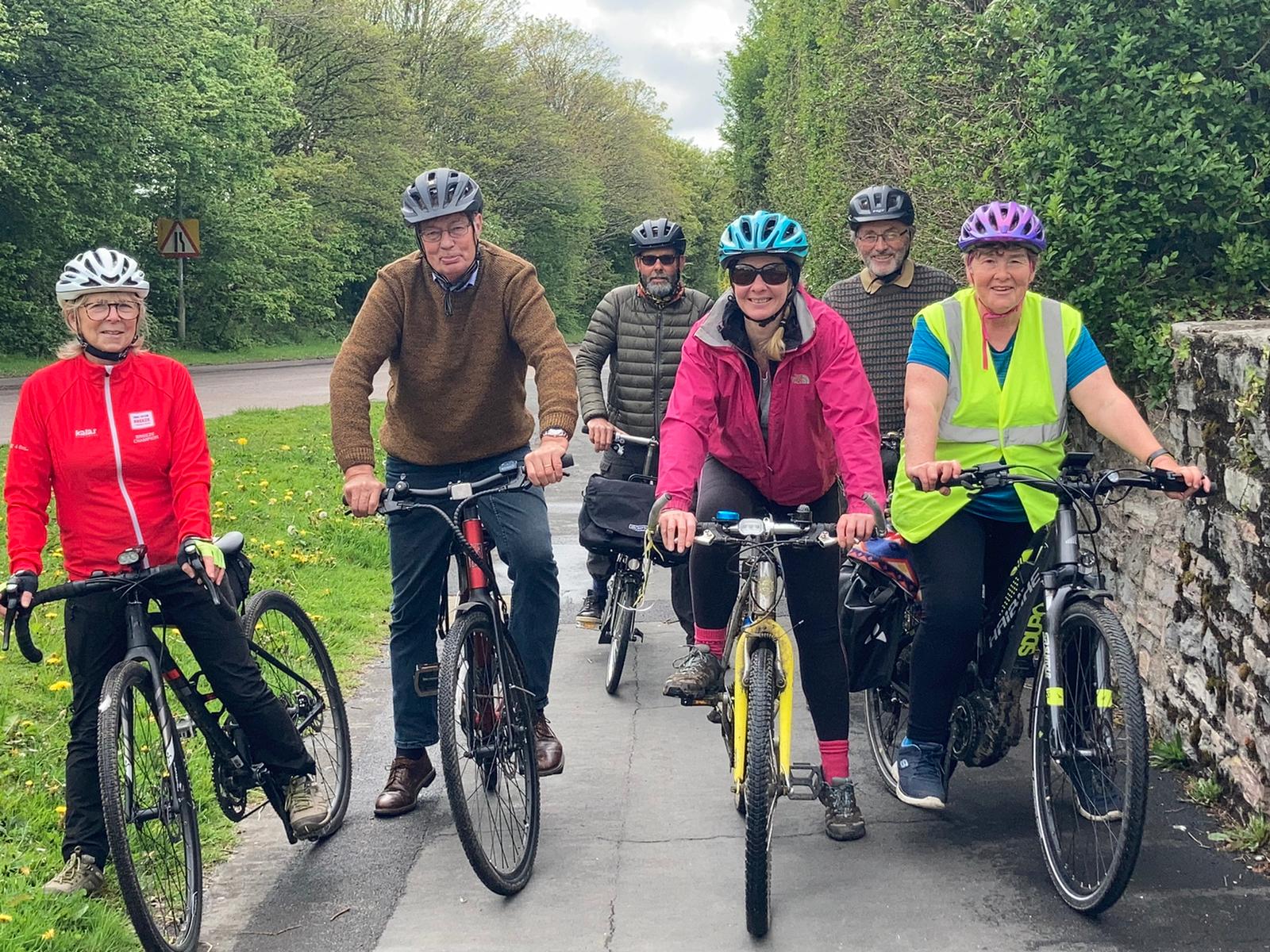
Following numerous representations about the poor state of our footpaths and cycle lanes, South West Devon M.P., Sir Gary Streeter invited representatives from local community groups to show him on site the four most notorious black spots on the primary route linking Ivybridge with Plymouth.
Sir Gary used his bike to view two hot spots at Lee Mill and Western Road roundabout in Ivybridge. He also visited Cot Hill junction and the Ridgeway in Plympton. This route links Plymouth City Centre, Drakes Trail, Saltram and the Barbican with Ivybridge, southern Dartmoor and the South Hams.
The community groups were lead by Graham Wilson, Chair of PL21 Transition Initiative and invitees included John Abraham, Chair of Plymouth Cycling Campaign together with local residents from Plymouth, Lee Mill, Yealmpton and Ivybridge.
“People come to us saying how our roads are dominated by cars and they don’t feel safe on foot or bike. They say that the footpaths are too narrow, there are few proper crossings, there is nowhere for children to cycle and disabled people including wheelchair users are especially discriminated against by the way some streets or places are designed. Many people say that they would prefer to
cycle to work but it is not safe so they drive instead” says Graham.
“A safer commuting/leisure cycling route linking Plymouth city centre to Plympton, Lee Mill, Ivybridge and South Hams towns beyond has been a long-standing ambition. Much of this route exists, but a number of dangerous crossings prevent it meeting the criteria for a safe route, one of which is that it should be suitable for an unaccompanied 12 year old. Imaginative solutions have been proposed for these ‘hot spots’, but it needs the political will to allocate funding, which currently prioritises roads over sustainable transport” comments John.
Ally Kohler, Director of Conservation and Communities responds saying “Dartmoor National Park Authority welcomes opportunities to improve and develop safe green and active travel routes to and from the National Park that support both leisure and utility journeys. The Dartmoor National Park Management Plan Review promotes the need for a green transport plan for the National Park and recognises the potential of the A38 corridor to provide green transport links to connect communities and provide a resource for leisure and tourism.”Sir Gary says that “It was really informative to meet with local cycling groups and residents on site in Plympton and Ivybridge. Seeing the challenges local cyclists face for myself brought home the issues and the need for action if we are to encourage active travel as a solution to climate change and for health and well-being purposes. I am meeting with South Devon local authorities and Sustrans to discuss our proposals for cycling across the area in late June. I hope we can collaborate on a series of priorities and engage interested parties thereafter to see if we can progress it looking at all of the issues involved. It is not going to be easy, but we certainly need a better plan than we currently have”
A professional report for the Ivybridge area involving the community, town council, community college with four public drop in meetings and organised jointly by Sustrans, Ivybridge Town Council and PL:21 Transition Initiative was undertaken in 2019 with update this year. There was consensus that the public highways are deficient locally with significant barriers that deters active travel.
————————————————————————————————
August 7th 2020:
Plymouth Cycling Campaign (PCyC) and Plymouth City Council (PCC) agree new Strategic Liaison Group
Over the last few months dealings between ouselves and the city council have been frustrated by poor communication and lack of transparency over key decisions. We have continued to push for positive change for cyclists and cycling in Plymouth and have kept up our lobbying. We are pleased to say that this has led to the setting up of a Strategic Liaison Group with senior officers from the city council and committee members from PCyC agreeing to meet on a three monthly basis.
The first of these meetings took place earlier this week and the main focus for discussion was the detail of the recent successful Transforming Cities Fund bid from which PCC has secured an initial £7.6m in tranche 1 with a further £51.2m in tranche 2. This funding is for sustainable transport schemes in general but does include welcome improvements to cycling infrastructure and measures to boost cycling in the city. One of the council officers leading this scheme will be giving us a more detailed briefing on TCF and an overview of the elements of the bid can be found here: https://www.plymouth.gov.uk/parkingandtravel/transportplansandprojects/transportplans/transformingcitiesfund
We also discussed the Emergency Active Travel funding package. Plymouth was successful in getting the full allocation of £249 000 in tranche 1 which will fund a city centre cycle path along Armada Way and a variety of other measures, some of which we have campaigned for over a long period such as mandatory restrictions on parking in cycle lanes on Devonport Hill and Billacombe Road, introduction of cycle contraflows and removal of cycle lane barriers.
The bid for the second tranche of funding worth almost one million pounds has to be submitted by 7 August. This funding must be spent by March 2021 so there are limits on what is deliverable in that timescale. We have again submitted a number of schemes including reallocation of road space, safety improvements on roundabouts and crossings, further contraflows, safety and signing improvements that we believe will make it easier and safer for people to cycle around Plymouth. While this is billed as emergency funding the clear intention is that measures put in place should become permanent.
We were able to make clear that a number of the Campaign’s priorities have not yet been addressed, and as more funding becomes available we will continue to raise these at our quarterly meetings with the Council. For an overview of what we are campaigning for, visit our Campaigns page.
In the next meeting of the Strategic Liaison Group we will review progress on the TCF and Emergency Active Travel Fund and want to discuss the next annual Climate Emergency Action Plan.
 Plymouth Cycling Campaign